L’automatisation est devenue un incontournable, aussi bien pour les entreprises que pour les professionnels individuels.
Que vous soyez un utilisateur TI (développeur, architecte de données, ingénieur logiciel) ou non-TI (gestionnaire, analyste, entrepreneur), vous entendez sûrement parler d’outils comme n8n et SIM.IA.
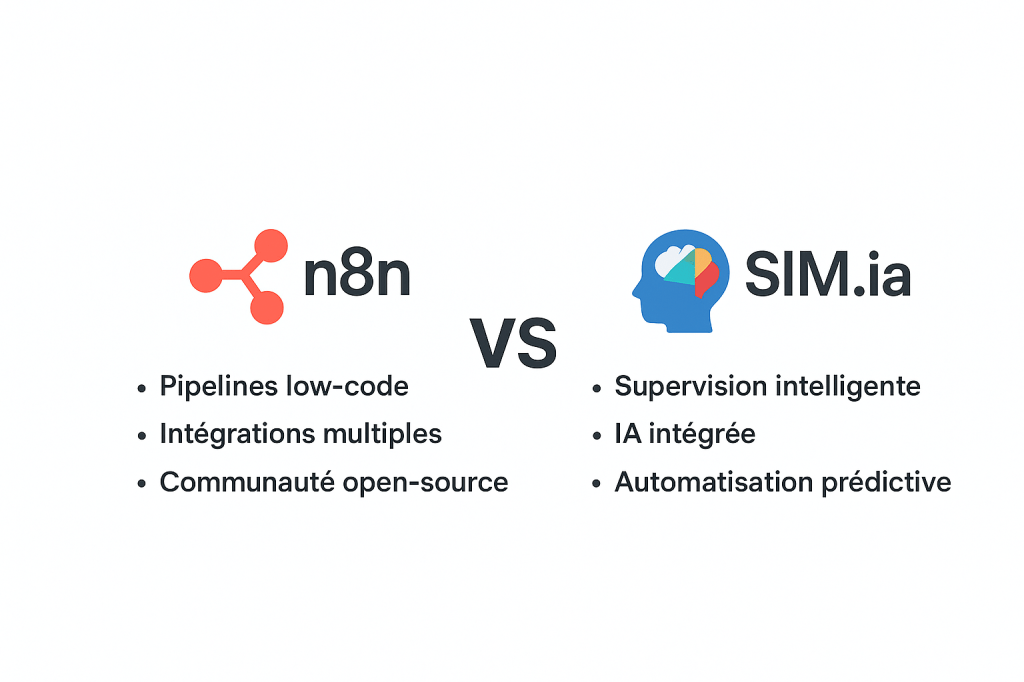
Ces deux plateformes permettent de créer des workflows automatisés, de connecter des applications entre elles et d’utiliser l’intelligence artificielle pour simplifier les tâches répétitives. Mais quelles sont les différences ? Et laquelle convient le mieux à vos besoins ?
Qu’est-ce que n8n ?
n8n (se prononce n-eight-n) est une plateforme open-source qui permet de :
connecter des centaines d’applications (CRM, bases de données, APIs, services cloud, etc.) ;
créer des workflows avancés avec une logique conditionnelle, des boucles et de la gestion d’erreurs ;
intégrer facilement des modèles d’IA pour enrichir les processus ;
s’exécuter en cloud ou en auto-hébergement (pratique pour garder le contrôle sur ses données).
👉 En clair : n8n est une boîte à outils ultra flexible, qui s’adresse à ceux qui veulent automatiser de façon précise, avec la possibilité d’ajouter du code pour des cas complexes.
Qu’est-ce que SIM.IA ?
SIM.IA est une plateforme plus récente, également orientée no-code/low-code, conçue spécifiquement pour :
créer des agents IA intelligents qui interagissent avec les données et les utilisateurs ;
connecter facilement plusieurs modèles de langage (OpenAI, Anthropic, Google, Ollama, etc.) ;
simplifier la création de pipelines IA, même sans compétences en programmation ;
offrir une expérience plus “clé en main” pour les projets d’automatisation centrés sur l’intelligence artificielle.
👉 En clair : SIM.IA est idéale pour démarrer rapidement avec l’IA, créer des agents intelligents et prototyper des cas d’usage sans se perdre dans la complexité technique.
Comparaison n8n vs SIM.IA
Critère n8n SIM.IA Public cible Développeurs, équipes TI, utilisateurs avancés Utilisateurs non-TI, équipes métier, prototypage IA Type d’automatisation Workflows complexes, intégrations multiples, forte personnalisation Agents IA, automatisations rapides orientées intelligence artificielle Courbe d’apprentissage Plus technique, nécessite parfois du code Plus intuitive, orientée glisser-déposer Hébergement Cloud + self-hosted (flexibilité totale) Cloud, open-source (selon version) Maturité Communauté solide, nombreux connecteurs, documentation riche Jeune mais en croissance, focus sur l’IA Cas d’usage typiques Orchestration de données, intégrations B2B, automatisations critiques Chatbots IA, assistants intelligents, automatisation simple avec IA intégrée
Exemple concret
Entreprise TI (développeurs, architectes) : une équipe veut orchestrer des flux de données entre Salesforce, Snowflake et Azure, avec des conditions complexes. 👉 n8n est plus adapté.
Entreprise non-TI (marketing, RH, PME) : une équipe veut créer un agent IA capable de répondre aux questions fréquentes des employés à partir d’un document interne. 👉 SIM.IA est plus simple à mettre en place.
Conclusion
En 2025, n8n et SIM.IA ne s’opposent pas vraiment, mais se complètent.
Si vous recherchez puissance, flexibilité et contrôle total → n8n est votre allié.
Si vous cherchez une solution rapide, intuitive et centrée sur l’IA → SIM.IA est un excellent choix.
Le plus important est de définir vos besoins réels : automatiser des processus métiers complexes ou expérimenter rapidement avec l’intelligence artificielle ?
🚀 Passez à l’action
Vous hésitez encore entre n8n et SIM.IA ? 👉 Dans un prochain article, je partagerai un guide pratique pour démarrer avec chaque outil, avec des cas d’usage concrets.
n8n vs SIM.IA, comparaison automatisation no-code, agents IA, workflows automatisés, plateforme open-source, alternative Zapier, automatisation TI et non TI.
Ah, artificial intelligence! It’s talked about everywhere, and yet, when I chat with friends or colleagues, I realize that many still confuse the different types of AI that exist today. If you also feel lost in this technological jungle, don’t worry – I’ve been there!
After months of research and personal experimentation with different AI technologies, I decided to create this guide to demystify it all. So, get comfortable with your coffee (or tea), and let’s dive together into the fascinating world of artificial intelligence.
ANI, AGI, ASI: The Trio That Defines the Evolution of Artificial Intelligence
Let’s start with the basics: the three major categories of artificial intelligence that structure our understanding of this field.
ANI: Artificial Narrow Intelligence
ANI (also called weak AI) is what we use every day. It’s specialized AI, designed to excel at a specific task but unable to step outside its area of expertise.
Your voice assistant that reminds you to buy milk? ANI. The system that recommends movies on Netflix? ANI. The algorithm that detects fraud on your credit card? Also ANI.
These systems are impressive in their domain, but they don’t truly “understand” what they’re doing – they execute sophisticated algorithms without genuine awareness or ability to transfer learning.
I still remember my surprise when I asked Siri to tell me a joke and then explain why it was funny… Total failure! And that’s normal: Siri can recite pre-programmed jokes, but doesn’t understand humor. This is the fundamental limitation of ANI.
AGI: Artificial General Intelligence
AGI (or strong AI) remains largely theoretical. It would be an AI capable of understanding, learning, and applying its knowledge to any intellectual problem – like a human, with the same cognitive flexibility.
A true AGI could:
Learn any intellectual task
Transfer knowledge from one domain to another
Understand abstract concepts
Plan, reason, and solve novel problems
Possess a form of self-awareness
This is the type of AI we see in movies like “Her” or “Ex Machina” – machines capable of natural conversations, adaptability, and autonomous learning.
Between us, despite sensationalist headlines, we’re still very far from true AGI. The most optimistic estimates talk about a decade, the most conservative ones several decades. Some experts even doubt we’ll ever achieve it.
ASI: Artificial Superintelligence
ASI represents the theoretical next step: artificial intelligence that would surpass not only human intelligence in specific domains (as is already the case for chess or Go), but in virtually all intellectual domains.
An ASI could:
Solve scientific problems that we cannot understand
Innovate technologically at a dizzying pace
Potentially improve itself, creating an “intelligence explosion”
This form of intelligence is both fascinating and concerning. It’s the concept at the heart of the concerns of researchers like Nick Bostrom or the warnings from Elon Musk.
The reality? ASI remains pure science fiction for now. We don’t even know if it’s theoretically possible, or what forms it might take.
Practical Comparison of the Three Types of AI
In practice, all AI systems you use today are ANI, even the most impressive ones like ChatGPT or DALL-E. These systems can give the illusion of general understanding, but remain fundamentally specialized systems – extremely sophisticated certainly – but without true understanding of the world.
The Main Categories of AI You Probably Encounter
1. Machine Learning
Machine learning has become the engine of most modern AI applications. It’s an approach where the algorithm “learns” from data instead of being explicitly programmed.
I recently tested a machine learning system to automatically sort my vacation photos. At first, I had to identify a few faces, then as if by magic, the algorithm started recognizing my friends in all photos. Mind-blowing!
Some important sub-categories:
Supervised learning: The algorithm is provided with labeled examples (like emails marked “spam” or “not spam”) and learns to classify new examples.
Unsupervised learning: The algorithm looks for hidden structures in unlabeled data. For example, grouping customers into segments based on their purchasing behaviors.
Reinforcement learning: The algorithm learns by trial and error, receiving “rewards” when it makes the right choices. This is how AlphaGo AI beat human champions at the game of Go.
2. Deep Neural Networks (Deep Learning)
Deep learning is a branch of machine learning that uses artificial neural networks with multiple layers to analyze complex data.
It’s the technology behind applications like:
Image recognition (how Instagram knows to recognize a face)
Automatic translation (Google Translate has improved enormously thanks to this)
Content generation (like models that create images from text)
I admit I was skeptical until I tried DALL-E for the first time. I typed “an astronaut cat floating in space with Earth in the background” and the generated image was stunningly realistic. These systems don’t just assemble existing images – they truly create new content.
3. Large Language Models (LLMs)
If you’ve used ChatGPT, you’ve interacted with an LLM. These models are trained on enormous quantities of text to predict and generate human language.
What fascinates me about these models is their ability to seemingly understand context. I can have a conversation that spans multiple questions, and the model maintains impressive coherence. Of course, they have their limitations – they can “hallucinate” information or get facts wrong, but their apparent mastery of language is remarkable.
4. Conversational AI
Chatbots and virtual assistants often use a combination of techniques to simulate human conversation.
I use an AI assistant to manage my emails, and honestly, some of my contacts don’t even suspect they’re sometimes communicating with an AI! These systems are becoming so natural that they almost pass the Turing test in limited contexts.
5. Computer Vision
This branch of AI allows machines to interpret and understand visual content. It’s used in autonomous cars, facial recognition, medical analysis, and much more.
My recent car uses computer vision to detect speed limits and warn me if I start to drift out of my lane. It’s both fascinating and a little unnerving to see how these systems can “understand” what they see.
Emerging AI Technologies That Will Shape the Future
1. Multimodal AI
Multimodal systems can process and combine different types of information: text, image, sound, video…
For example, you can show a photo to some recent models and ask them questions about it. Or ask them to generate an image from a textual description, then modify it according to your instructions.
I recently used a multimodal system to create a logo for my personal project. I was able to describe what I wanted, see a first draft, then verbally refine it (“make the colors more vibrant,” “enlarge the central symbol”) without having to touch design software. The time saving is considerable!
2. Generative AI
These systems can create original content: texts, images, music, computer code…
Beyond well-known examples like ChatGPT for text or DALL-E for images, we’re seeing tools like MuseNet that composes music in different styles, or GitHub Copilot that helps developers write code.
A musician friend uses AI to help compose his melodies. It’s not about replacing his creativity, but rather exploring new directions he wouldn’t have thought of.
3. Symbolic AI and Hybrid Systems
After years of enthusiasm for “pure” machine learning, we’re witnessing a return of symbolic AI, which uses logic and explicit representations of knowledge.
Hybrid systems, combining deep learning and symbolic approaches, promise to solve some current limitations, particularly in reasoning.
Ethical and Societal Challenges of Different Types of AI
Each type of AI raises specific questions:
Facial recognition systems pose privacy and surveillance problems.
Generative models facilitate the creation of deepfakes and misinformation.
Intelligent automation is transforming the job market, creating and destroying jobs.
I remain convinced that education is the best response to these challenges. The more we understand these technologies, the better we can regulate and use them wisely.
How to Choose the Right AI for Your Project?
If you’re considering integrating AI into your business or personal project, ask yourself these questions:
What is my specific problem? Different types of AI excel at different tasks.
What data do I have? Without quality data, even the most sophisticated algorithms will be ineffective.
Do I need explanations for the AI’s decisions? Some models are more “transparent” than others.
What are my technical and budget constraints? AI solutions vary enormously in terms of cost and complexity.
Conclusion: The Future is Hybrid
I’m convinced that the future of AI won’t be dominated by a single approach, but by hybrid systems combining different techniques to overcome their respective weaknesses.
What about you, which AI technology intrigues you the most? Have you already experimented with some of them? Share your experience in the comments – I love discovering new creative uses of these technologies!
Discover the complete architecture of Microsoft Copilot Studio for creating intelligent copilots integrated with Power Platform, Azure OpenAI, and Dynamics 365. Boost your business processes with conversational AI!
Introduction
Artificial intelligence is revolutionizing business productivity. With Microsoft Copilot Studio, you can create custom AI assistants without coding. But behind its user-friendly interface lies a sophisticated architecture that orchestrates generative AI, automation, and business integration. In this article, explore the architecture of Copilot Studio and learn how to build powerful copilots to transform your business.
What is Microsoft Copilot Studio?
Copilot Studio is the evolution of Power Virtual Agents within the Power Platform. It allows you to design copilots capable of:
Understanding natural language,
Triggering automation,
Integrating with your business systems (Microsoft 365, Dynamics 365, Dataverse, etc.).
Thanks to Azure OpenAI, Copilot Studio uses generative AI to enhance its responses and streamline the user experience.
Overview of Copilot Studio Architecture
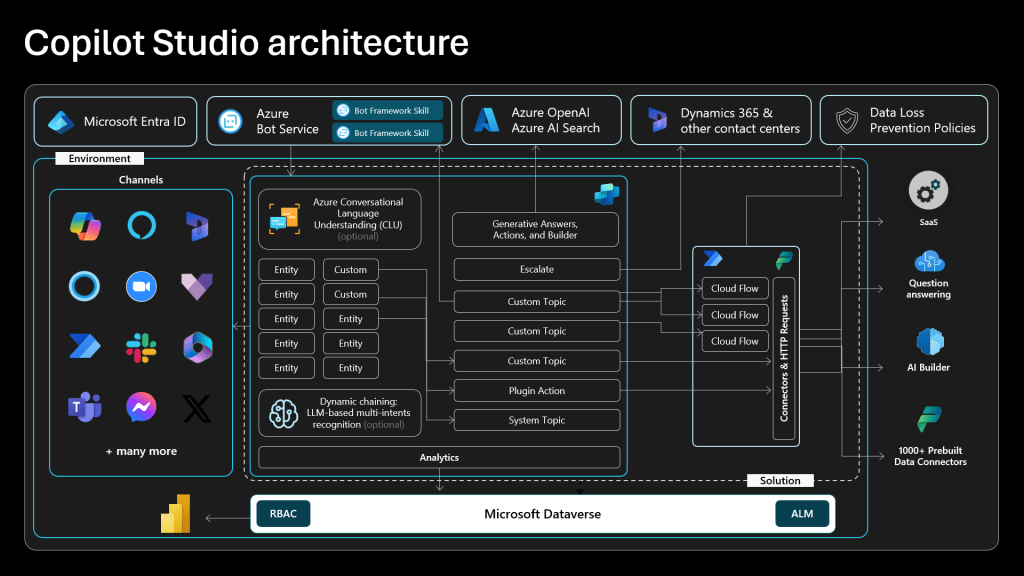
Creating an effective copilot relies on a robust and modular architecture. Here’s how Copilot Studio’s architecture is structured:
Architecture Diagram:
Logical Architecture of Copilot Studio
Key Components of Copilot Studio Architecture
Low-Code Creation Interface
Visual construction of dialogs.
Definition of prompts, flows, and connectors.
AI Orchestrator
Analyzes each user request.
Chooses the best strategy: generative AI, automated action, or querying a database.
Azure OpenAI Integration
Uses GPT models to generate natural and contextualized responses.
Power Platform Connectors & Plugins
Links to Dynamics 365, Dataverse, SQL Server, SharePoint, Salesforce, and more.
Develops custom plugins via secure APIs.
Lifecycle of a Request in Copilot Studio
The user formulates a request.
Copilot Studio sends it to the Prompt Orchestration Layer.
The orchestrator:
Activates GPT for an AI-generated response,
Triggers a Power Automate flow to execute a business action,
Or queries your databases directly.
An enriched response is generated.
The response is returned to the user in their environment (Teams, website, etc.).
Security and Governance in Copilot Studio
Microsoft Copilot Studio is designed to meet the most demanding standards:
Secure authentication with Microsoft Entra ID (formerly Azure Active Directory).
Detailed audit logs.
Control over data privacy used in prompts.
GDPR compliance ensured.
Real-World Application Examples
HR Copilot: Answers employee questions about leave and integrates with Dynamics 365 HR.
Customer Service Copilot: Searches knowledge bases and automatically creates tickets.
Finance Copilot: Extracts financial KPIs directly from Power BI or Dataverse.
Best Practices for Optimizing Your Copilot Studio
Modularize your flows for greater flexibility.
Set up fallback prompts in case of failure.
Monitor conversational performance using built-in analytics.
Train your prompts to match specific business needs.
Conclusion: Why Mastering Copilot Studio Architecture is Key?
The Copilot Studio Architecture represents much more than just a tool for creating virtual assistants. It is a complete AI orchestration platform offering customization, scalability, and security. By understanding this architecture, you will be able to:
Design truly useful copilots,
Accelerate your business processes,
Deliver highly personalized AI experiences.
🚀 Ready to design your own Copilot? Discover Microsoft Copilot Studio and get started today!
Quick FAQ on Copilot Studio Architecture
How does Microsoft Copilot Studio architecture work? Copilot Studio uses an AI orchestration layer to dynamically select the best response (GPT, database, or automated action) based on each user request.
Is Copilot Studio secure? Yes, it relies on Microsoft Entra ID for identity management and includes comprehensive audits for GDPR compliance.
Can I integrate custom APIs into Copilot Studio? Absolutely. Thanks to custom plugins, you can securely integrate any external service.
Discover how AI is transforming Business Intelligence (BI), how BI strengthens AI models, and why data quality is the cornerstone of successful AI-augmented BI strategies.
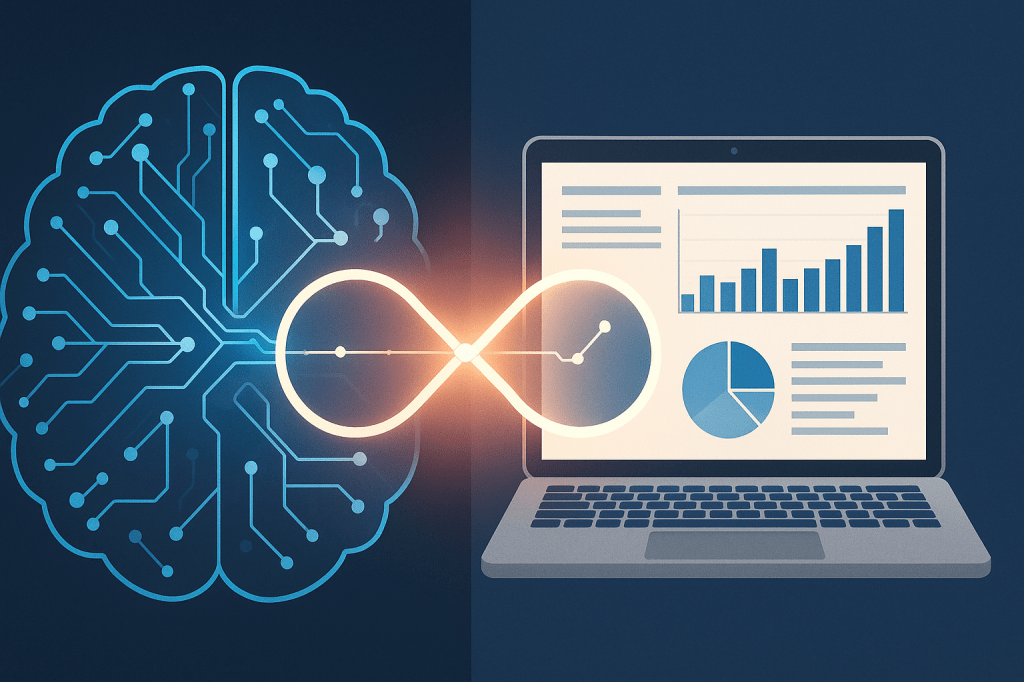
In today’s data-driven economy, Artificial Intelligence (AI) and Business Intelligence (BI) are no longer separate forces — they are evolving together to transform how organizations understand, predict, and act. AI is supercharging BI platforms with advanced capabilities like predictive analytics, automated insights, and natural language querying. At the same time, modern BI systems are feeding AI models with better, cleaner, and richer data than ever before.
But this powerful relationship hinges on one critical element: data quality. Without high-quality data, even the most advanced AI-powered BI tools can fail.
Let’s dive into how AI powers BI, how BI enables smarter AI, and why maintaining data integrity is vital for sustainable success.
How AI Powers Business Intelligence
AI is revolutionizing the way we use Business Intelligence by adding intelligence and automation across every step of the data lifecycle.
1. Predictive and Prescriptive Analytics
AI algorithms help BI systems move beyond describing what happened to predicting what will happen — and even prescribing the best actions to take. This elevates BI from a retrospective tool to a forward-looking strategic advisor.
2. Natural Language Processing (NLP)
AI-powered NLP allows users to interact with BI platforms through simple questions — no SQL or coding required. For example, typing “Show me last quarter’s sales trends” can instantly generate dynamic visualizations.
3. Automated Insights
Modern BI platforms equipped with AI automatically surface anomalies, trends, and correlations without human intervention. This shortens the time to insight and enables faster, data-driven decision-making.
4. Smart Data Preparation
AI accelerates data wrangling by suggesting data transformations, detecting duplicates, and identifying missing fields, allowing analysts to focus more on interpretation than cleaning.
How BI Enables Smarter AI
While AI enhances BI, the relationship is symbiotic: Business Intelligence also strengthens AI initiatives.
1. Richer Data Ecosystems
Modern BI platforms consolidate diverse data sources — structured, unstructured, and semi-structured — creating richer training datasets for AI models.
2. Data Governance and Stewardship
Strong BI governance ensures that data feeding AI algorithms is clean, consistent, and trustworthy. Without this, AI models risk learning from biased or incomplete datasets.
3. Enhanced Feature Engineering
BI systems help identify key variables and relationships that inform feature engineering — a critical step in developing effective machine learning models.
4. Faster Experimentation
Self-service BI enables analysts and data scientists to rapidly test hypotheses, visualize data, and iterate on AI models, speeding up innovation cycles.
The Critical Role of Data Quality: Garbage In, Garbage Out
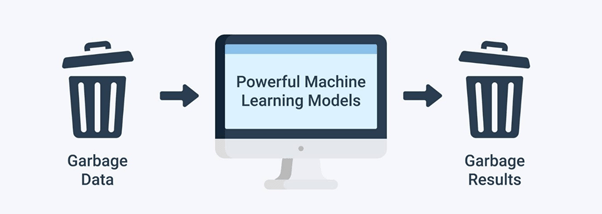
Despite all the technological advances, one timeless truth remains: Garbage In, Garbage Out (GIGO).
If you feed poor-quality, incomplete, or biased data into your AI models or BI dashboards, the insights generated will be equally flawed — no matter how powerful your tools are.
Why Data Quality Matters More Than Ever:
AI models trained on bad data produce inaccurate predictions.
BI platforms visualizing incomplete or outdated data mislead decision-makers.
Poor data governance exposes organizations to compliance risks and reputational damage.
Key takeaway: Without trusted data, there is no trusted intelligence.
Best Practices to Ensure High Data Quality:
Automated Data Validation: Use AI tools to automatically detect and correct errors before they impact reporting or model training.
Robust Data Governance: Establish clear rules for data ownership, access control, and lineage tracking.
Continuous Data Monitoring: Implement real-time quality checks to catch issues early.
Comprehensive Metadata Management: Maintain catalogs that document sources, transformations, and intended uses of each dataset.
When you ensure the quality of your input data, you maximize the value of your AI-powered BI systems — unlocking smarter, faster, and more trustworthy decisions.
Key Benefits of AI-Augmented BI
Organizations that successfully combine AI and BI while maintaining strong data quality enjoy significant advantages:
Increased Operational Efficiency Automated data preparation and anomaly detection free up valuable human resources.
Deeper Strategic Insights Prescriptive analytics offer not just explanations but actionable recommendations.
Greater Competitive Advantage Data-driven innovation powered by AI provides early mover advantage in rapidly changing markets.
Future Trends: The Convergence of AI and BI
The future of BI will be even more intelligent, automated, and proactive, with emerging trends such as:
Conversational BI Interfaces: Voice-activated BI tools using AI-powered assistants.
Hyper-Personalized Dashboards: Customized visualizations and recommendations based on user behavior.
AutoML Embedded in BI: Drag-and-drop machine learning inside BI platforms for business users.
Ethical and Explainable AI: Increased focus on making AI-driven insights transparent, ethical, and auditable.
Real-world Examples of AI and BI Synergy
Retail: Predicting customer churn and recommending targeted promotions.
Healthcare: Real-time patient risk scoring based on dynamic clinical data.
Finance: Automated fraud detection and credit risk modeling.
Manufacturing: Predictive maintenance of equipment based on IoT sensor data.
Across every sector, the AI + BI combination is driving better outcomes, higher profits, and smarter strategies.
Conclusion: Trusted Data, Trusted Intelligence
The fusion of AI and BI is reshaping how organizations create, interpret, and act on data. But no amount of AI or advanced BI features can compensate for bad data. The principle of “Garbage In, Garbage Out” is more relevant than ever in today’s hyperconnected world.
To truly harness the power of AI-powered BI, companies must invest in strong data governance, robust data quality practices, and a culture that values trusted intelligence.
The future belongs to those who trust their data — and act on it wisely.
Bonus: Want to know where to start?
Begin with strong data governance (BI foundation).
Then layer on AI gradually — starting with simple automated insights before moving to full predictive analytics.
Most importantly, make sure business users are part of the journey!



 MasterDataDNA