
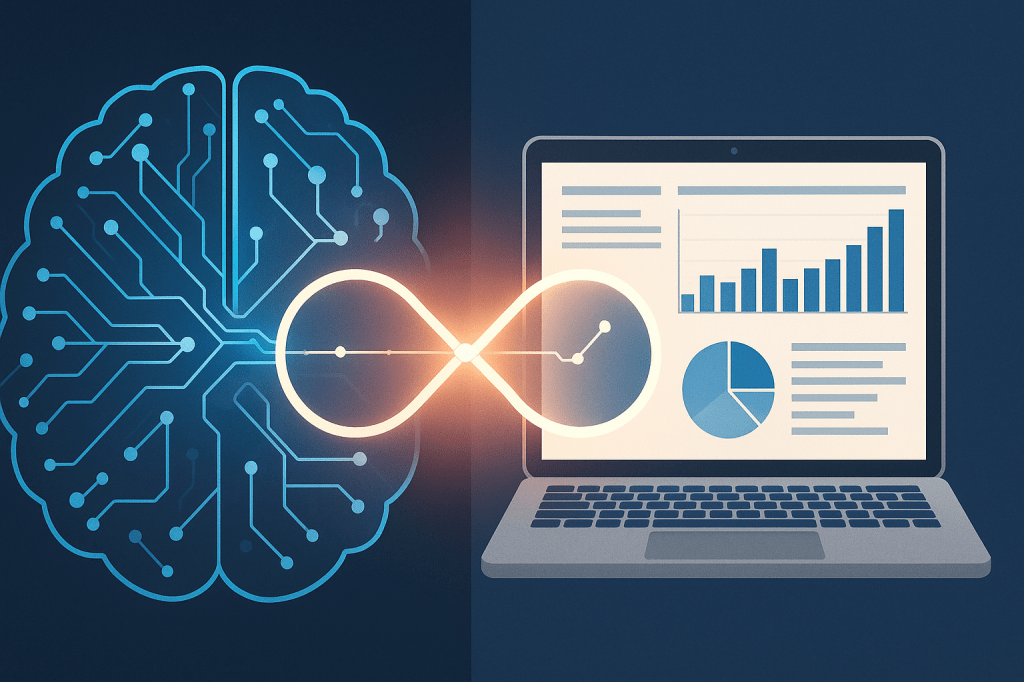
Discover how AI is transforming Business Intelligence (BI), how BI strengthens AI models, and why data quality is the cornerstone of successful AI-augmented BI strategies.
In today’s data-driven economy, Artificial Intelligence (AI) and Business Intelligence (BI) are no longer separate forces — they are evolving together to transform how organizations understand, predict, and act.
AI is supercharging BI platforms with advanced capabilities like predictive analytics, automated insights, and natural language querying. At the same time, modern BI systems are feeding AI models with better, cleaner, and richer data than ever before.
But this powerful relationship hinges on one critical element: data quality. Without high-quality data, even the most advanced AI-powered BI tools can fail.
Let’s dive into how AI powers BI, how BI enables smarter AI, and why maintaining data integrity is vital for sustainable success.
How AI Powers Business Intelligence
AI is revolutionizing the way we use Business Intelligence by adding intelligence and automation across every step of the data lifecycle.
1. Predictive and Prescriptive Analytics
AI algorithms help BI systems move beyond describing what happened to predicting what will happen — and even prescribing the best actions to take.
This elevates BI from a retrospective tool to a forward-looking strategic advisor.
2. Natural Language Processing (NLP)
AI-powered NLP allows users to interact with BI platforms through simple questions — no SQL or coding required.
For example, typing “Show me last quarter’s sales trends” can instantly generate dynamic visualizations.
3. Automated Insights
Modern BI platforms equipped with AI automatically surface anomalies, trends, and correlations without human intervention.
This shortens the time to insight and enables faster, data-driven decision-making.
4. Smart Data Preparation
AI accelerates data wrangling by suggesting data transformations, detecting duplicates, and identifying missing fields, allowing analysts to focus more on interpretation than cleaning.
How BI Enables Smarter AI
While AI enhances BI, the relationship is symbiotic: Business Intelligence also strengthens AI initiatives.
1. Richer Data Ecosystems
Modern BI platforms consolidate diverse data sources — structured, unstructured, and semi-structured — creating richer training datasets for AI models.
2. Data Governance and Stewardship
Strong BI governance ensures that data feeding AI algorithms is clean, consistent, and trustworthy.
Without this, AI models risk learning from biased or incomplete datasets.
3. Enhanced Feature Engineering
BI systems help identify key variables and relationships that inform feature engineering — a critical step in developing effective machine learning models.
4. Faster Experimentation
Self-service BI enables analysts and data scientists to rapidly test hypotheses, visualize data, and iterate on AI models, speeding up innovation cycles.
The Critical Role of Data Quality: Garbage In, Garbage Out
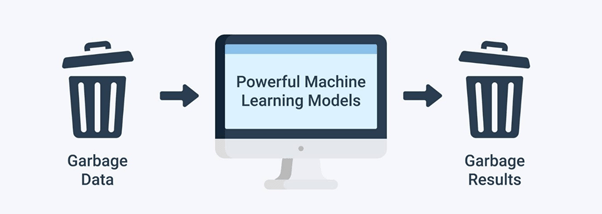
Despite all the technological advances, one timeless truth remains:
Garbage In, Garbage Out (GIGO).
If you feed poor-quality, incomplete, or biased data into your AI models or BI dashboards, the insights generated will be equally flawed — no matter how powerful your tools are.
Why Data Quality Matters More Than Ever:
- AI models trained on bad data produce inaccurate predictions.
- BI platforms visualizing incomplete or outdated data mislead decision-makers.
- Poor data governance exposes organizations to compliance risks and reputational damage.
Key takeaway:
Without trusted data, there is no trusted intelligence.
Best Practices to Ensure High Data Quality:
- Automated Data Validation:
Use AI tools to automatically detect and correct errors before they impact reporting or model training. - Robust Data Governance:
Establish clear rules for data ownership, access control, and lineage tracking. - Continuous Data Monitoring:
Implement real-time quality checks to catch issues early. - Comprehensive Metadata Management:
Maintain catalogs that document sources, transformations, and intended uses of each dataset.
When you ensure the quality of your input data, you maximize the value of your AI-powered BI systems — unlocking smarter, faster, and more trustworthy decisions.
Key Benefits of AI-Augmented BI
Organizations that successfully combine AI and BI while maintaining strong data quality enjoy significant advantages:
- Faster Decision-Making
Real-time insights fueled by predictive analytics enable immediate action. - Increased Operational Efficiency
Automated data preparation and anomaly detection free up valuable human resources. - Deeper Strategic Insights
Prescriptive analytics offer not just explanations but actionable recommendations. - Greater Competitive Advantage
Data-driven innovation powered by AI provides early mover advantage in rapidly changing markets.
Future Trends: The Convergence of AI and BI
The future of BI will be even more intelligent, automated, and proactive, with emerging trends such as:
- Conversational BI Interfaces:
Voice-activated BI tools using AI-powered assistants. - Hyper-Personalized Dashboards:
Customized visualizations and recommendations based on user behavior. - AutoML Embedded in BI:
Drag-and-drop machine learning inside BI platforms for business users. - Ethical and Explainable AI:
Increased focus on making AI-driven insights transparent, ethical, and auditable.
Real-world Examples of AI and BI Synergy
- Retail: Predicting customer churn and recommending targeted promotions.
- Healthcare: Real-time patient risk scoring based on dynamic clinical data.
- Finance: Automated fraud detection and credit risk modeling.
- Manufacturing: Predictive maintenance of equipment based on IoT sensor data.
Across every sector, the AI + BI combination is driving better outcomes, higher profits, and smarter strategies.
Conclusion: Trusted Data, Trusted Intelligence
The fusion of AI and BI is reshaping how organizations create, interpret, and act on data.
But no amount of AI or advanced BI features can compensate for bad data.
The principle of “Garbage In, Garbage Out” is more relevant than ever in today’s hyperconnected world.
To truly harness the power of AI-powered BI, companies must invest in strong data governance, robust data quality practices, and a culture that values trusted intelligence.
The future belongs to those who trust their data — and act on it wisely.
Bonus:
Want to know where to start?
- Begin with strong data governance (BI foundation).
- Then layer on AI gradually — starting with simple automated insights before moving to full predictive analytics.
- Most importantly, make sure business users are part of the journey!
 MasterDataDNA